Friday, December 28, 2012

Fulcrum Clears Financial Hurdle to Rev Up Construction in 2013


Three years after announcing its breakthrough in converting MSW to ethanol, Fulcrum BioEnergy appears to have secured all the funding necessary for its first MSW to low-carbon fuels plant in Storey County, located 20 miles east of Reno, Nev.

The Pleasanton, Calif.-based company landed a $105 million loan guarantee by the U.S. Department of Agriculture in August. Fulcrum originally filed a registration for an initial public offering with the Securities and Exchange Commission in September 2011 but rescinded its filing later.

Courtesy: Fulcrum BioEnergy
“The current IPO market environment remains challenging, especially for development stage companies like Fulcrum,” President and CEO James Macias said. “Because of this we have secured commitments from alternative capital resources to advance our MSW to renewable fuel program and we have withdrawn our registration statement.”

Fulcrum also closed an equity investment agreement with Waste Management in November 2011 that could provide up to $70 million for the Sierra BioFuels plant. The proposed plant is expected to produce close to 10 million gallons of ethanol each year. The company secured its feedstock and entered an offtake agreement for the plant in 2009. In addition to ethanol, the Sierra BioFuels plant will produce its own renewable energy to run the plant.

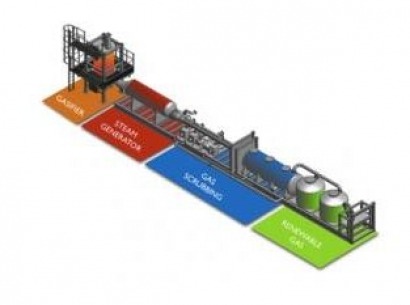
Fulcrum uses a two-step process to convert post-recycled MSW into ethanol. An InEnTec downdraft partial-oxidation gasifier is used to convert the sorted MSW to a syngas. The syngas then runs through a catalyst in Fulcrum’s proprietary alcohol synthesis process which it developed with Nipawin and the Saskatchewan Research Council before the ethanol is finally separated and purified.

The basis of Fulcrum’s business strategy is to secure zero-cost feedstock agreements around the country, thus giving it a competitive advantage over those who use corn or other forms of biomass. While Fulcrum has only just started construction on its Sierra BioFuels plant in Nevada, the company currently has feedstock agreements in 23 other cities across the U.S.

Better BTU: Fulcrum’s turning point was landing the $105 million loan from the USDA. The government has laid out significant dollars in an attempt to jumpstart development of biofuel technologies that utilize non-food feedstocks.  While we’d still like to see the industry focus on clearing one hurdle – clean, economic and efficient gasification – before approaching the next, we like Fulcrum’s business approach. Still a lot has to happen if the plant is to be in production by the end of 2013, as the company states. We’ll be keeping our eyes peeled for news out of Nevada.

Recommended Reading:

Fulcrum Secures $175M for Waste-to-Fuel Gasification Project – Waste Management World (Dec. 3, 2012)

$105 Million USDA Loan Guarantee for Waste-to-Biofuel Facility – Waste Management World (Aug. 7, 2012)

Thursday, December 13, 2012

DoD's $3M Award to Sierra Energy Proves Commitment to Renewable Energy


Government involvement in developing the renewable energy industry has gotten a bad rap over the years.  Certainly no one reading this blog needs to be reminded of the Solyndra debacle. Several recent moves by the Department of Defense, most notably its announcement that it awarding Sierra Energy a $3 million grant prove that the U.S. military is undeterred and committed to investing in renewable energy solutions, and we here at the Better BTU are glad to hear it.
Sierra Energy's FasOx Pathfinder.
Courtesy: Sierra Energy

The federal grant will allow California-based Sierra Energy to build a commercial-scale waste gasification system at U.S. Army Garrison Forth Hunter Liggett in Monterey County, Calif. The company currently has a demonstration model of its FastOx Pathfinder at the Renewable Energy Testing Center in McClellan Park and also received a $5 million grant from California Energy Commission to build a waste-to-biofuels demonstration facility at the Port of West Sacramento.

Read our previous technology blog: On the Right Track: Sierra Energy Gets Smaller

Fort Hunter Liggett is one of a handful of pilot installation sites that are part of the U.S. Army Net Zero Program, which focuses on addresses sustainability and energy security challenges. The military has divided the program into three areas, targeting energy, waste and water. Fort Hunter Liggett is one of the six installation sites chosen to be net-zero energy. The post serves a double purpose, as it is also one of the six sites selected to be net-zero waste by 2020.

“This project is part of Fort Hunter Liggett’s ongoing efforts to meet Net Zero standards for both waste and energy,” garrison commander Col. Donna Williams said. “Disposing of the installation’s waste and using it to generate clean energy meets both those goals.”

The Department of Defense is the nation’s largest consumer of energy, spending $4 billion on energy bills per year. Part of the cost comes from managing nearly 2.3 billion square feet of building space in 300,000 buildings worldwide (EERE Annual Energy Management Report).

The grant to Sierra Energy isn’t the only example of the military spending money to try to reduce its carbon footprint (and hopefully some $$ further down the line). Better BTU wrote about Edwards Air Force base testing out the IST Gem, a shipping container-sized WTE unit (IST Energy - Finding its Niche).  The U.S. Navy has also signed an agreement with Biodico to develop advanced biofuels in an effort to reduce dependence on foreign oil.

Better BTU Take: We’ve heard the arguments against government involvement in developing private industry and don’t necessarily disagree with them but we are encouraged to see the military continue to dedicate funds to developing renewable energy through gasification. As the largest consumers, finding a solution will have a large impact both economically and environmentally and it may allow technologies to lower prices as companies begin to recoup costs from building No. 001 and 002.

Recommended Reading:


Sierra Energy Lands Grant for Waste Gasification System – By Melanie Turner, Sacramento Business Journal (Nov. 16, 2012)

US Navy to Produce Biofuels, Bioenergy Worldwide – SustainableBusiness.com (Oct. 24, 2012)

Waste Reduction and Treatment in DoD Operations – Strategic Environmental Research and Development Program (SERDP)/Environmental Security Technology Certification Program (ESTCP)

Monday, October 15, 2012

Better BTU Update: Small Signs from Big Companies


You don’t have to wait for the big headlines for clues on what’s happening with companies on your watch list. Below we list small news items we’ve come across and what they could mean for big companies.

Rentech:

What’s Happening: The developer of technologies that enable the production of certified synthetic fuels and renewable power has announced that its third quarter conference call will take place on Nov. 8, 2012 at 11:00 PST. Rentech’s senior management will review the company’s financial results for the period and prove and update on corporate developments.

Why We Care:  Rentech is one of the few publicly owned companies in the biomass industry and is funded largely through its wholly-owned subsidiary, Rentech Nitrogen Partners. The company announced it was abandoning a number of projects as a result of cost-cutting measures during its 2011 fourth-quarter conference call.

Rentech has the patents to two different gasifiers as well as the iron-based catalyst that it mixes with liquid wax in a slurry bubble column reactor. Yet, neither SilvaGas nor the ClearFuels gasifiers turned out to be ready for commercial installation and the company was forced to take a step back and regroup.

Better BTU Take: We loved the company’s initiative but felt like Rentech was trying to go in too many places at once. Hopefully the company has had a chance to take a step back, refocus its plan and is ready to proceed. It will be interesting to see if Rentech returns to its previous projects or starts new ones.

 Plasco:

What’s Happening: We’ve noticed a host of advertisements for positions at Plasco Energy Group popping up across job search boards and on the company’s own website.

Why We Care: We haven’t heard anything about the proposed deal between the city of Ottawa and the local waste-to-energy company since The Ottawa Sun reported that the two sides were “very close” to a deal on Sept. 14. CFRA 580 News Talk Radio reported the deal would be inked before year’s end. Advertisements for positions including ‘Instrumentation and Control Technician’ and ‘Inventory Clerk’ at the Plasco Trail Road site go a long way in confirming these reports.

Better BTU Take: Companies aren’t going to begin hiring employees for site-specific positions until they are 99% sure the project will cross the finish line. We suppose we’ve become skeptics after hearing about so many projects that were close but fell apart at the 11th hour and we’ve been anxious to see if this one could make it. Seeing these advertisements is a great sign and we wish Plasco well!

Read our other blog posts on these companies:
Plasco Prepares to Cross the Finish Line in Contract Negotiations with Ottawa - Sept. 20, 2012 (Projects Blog)

Rentech in Reverse - April 24, 2012 (Technology Blog)

Finding Funding: Plasco's Biggest Supporter - Dec. 21, 2011 (Technology Blog)

Thursday, September 20, 2012

Plasco Prepares to Cross the Finish Line in Contract Negotiations with Ottawa


After nine months of negotiation with the city of Ottawa, it looks like Plasco Energy Group is “very close” to signing its first commercial deal.

Courtesy: Plasco Energy Group
The local company had reached an initial agreement in December to build and operate a facility that would convert 300 tons of post-recycled MSW per day using a plasma gasification system.  Plasma gasification heats the waste to temperatures above 4,000 degrees Fahrenheit to convert it to a syngas that can be used to generate electricity or steam.

The city has agreed to a 20-year deal that that would cost $9.1 million annually to send 300 tons of trash per day to the facility. While this is still a hefty price tag for residents, it is actually less than they are paying now to dump waste in the nearby Trail Road landfill. The city currently pays a $96 tip fee to landfill owners. The $9.1 million the city will pay annually to Plasco includes an $83.25 tip fee once the facility is up and running.  

Perhaps more importantly, the deal with Plasco will extend the life of the Trail Road landfill. Currently on pace to reach maximum capacity in 2042, the Plasco deal means the city would be able to continue dumping trash until 2070. The city estimates the cost of a new landfill to be close to $250 million.

A by-product of plasma gasification is slag, a non-toxic solid that looks like a shiny black rock. Plasco hopes to sell that slag as an aggregate for concrete or asphalt. Under the current deal with Ottawa, Plasco’s Trail Road facility would produce roughly 11,600 tons of slag each year. The city will receive the material at no cost and is hoping to use it to build a ramp to the landfill and facility. Slag is still untested as an aggregate for roadways since the current demonstration model does not run on a consistent enough basis to create large enough quantities of slag.

City council members have the distinct advantage of already seeing a commercial-scale demonstration of Plasco’s plasma gasification technology in its own backyard. The 100 tpd demonstration facility was built at the Trail Road landfill site in late 2010 and has been running intermittently ever since. The site passed its environmental screening test and received a Certificate of Approval (Air & Waste) on Oct. 24, 2011. Although some city council members have voiced fears that the facility had not been running on a continuous basis for a full year, the large size of the demonstration facility should ease concerns of scaling the technology for a larger facility.

Better BTU Take: Plasco Energy has received an unparalleled amount of financial support from private investors like George Soros (see our previous blog post Finding Funding: Plasco’s Biggest Supporter) and we’re glad to see something come of it. Plasma gasification is viewed as one of the cleanest forms of gasification but it’s the cost that is going to keep it from becoming a widespread solution on American soil. This technology can only work where tip fees are extremely high, as they are in Ottawa. That leaves New York and California as the best bets for a project in the states.

Interestingly enough, Plasco’s plan to build a facility in Salinas Valley, California has recently hit the skids. CalRecycle, the agency charged with overseeing California’s recycling and solid waste reduction notified Plasco on Aug. 23rd that its process didn’t appear to meet the state’s definition of gasification, preventing it’s electricity from receiving coveted ‘renewable energy’ status it needs to sell to utilities. The block comes almost two years after CalRecycle originally approved Plasco’s process and reports are that this is a purely political issue. Still, it hurts Plasco, who has already invested $1 million in the project.

Although there is no link between the Salinas Valley and Ottawa projects, it is worth noting that Plasco is still ironing out a deal to sell its energy to Ontario Power Authority. Should this become an issue at any point, there will be definite parallels between this project and the California one. Just goes to show you that nothing is certain ‘til the ink is dry and the facility is built and operating!

Further Reading:

Plasco Contract 'Very Close' to Completion – By Jon Willing, Ottawa Sun (Sept. 14, 2012)

Finding Funding: Plasco's Biggest Supporter – Better BTU Technology Blog (Dec. 21, 2011)

Plasco May Give Up California Dreamin' – By Joanne Chianello, Ottawa Citizen (Sept. 19, 2012)

Plasco Trail Road - 2011 Annual Report – Plasco Energy Group

City Hopes Plasco Slag is Hot Commodity – By Jon Willing, Ottawa Sun (Dec. 8, 2011)

Tuesday, August 21, 2012

ZeroPoint Clean Tech Powers Ahead with its Second Gasification Plant

ZeroPoint Clean Tech's biomass
gasification system in Newry,
Northern Ireland. 

A New York-based biomass renewable energy company that produces carbon-negative heat and power through high-temperature gasification announced its second commercial plant has gone live in Europe.

The 2MW gasification facility is located in Newry, Northern Ireland through the partnership of Kedco plc, a United Kingdom project developer. The plant is producing carbon-negative heat and power from agricultural and forestry waste. ZeroPoint Clean Tech’s gasification system creates biochar as a by-product, which is likely how the facility is able to achieve carbon-negative status. Putting biochar back into the ground sequesters the carbon and greatly improves plant growth, thereby making the entire process carbon negative.

Jonah Levine of Biochar Solutions explains that using the gas created by the gasifier to dry the feedstock before putting it through the gasification process can also help the facility receive a carbon negative status. We do not know if ZeroPoint Clean Tech uses this method or not.

Biochar is still highly underdeveloped in the industry as companies continue to explore the best uses for the fixed carbon form of highly porous charcoal that results from the thermal combustion process. One study estimates that biochar could offset as much as 12 percent of global greenhouse gas production. Reducing greenhouse gases is essential to slowing global warming and keeping low-lying islands like the Maldives from disappearing altogether.
ZeroPoint Clean Tech's gasification process.
Courtesy: ZeroPoint Clean Tech

The Newry, Northern Ireland facility is ZeroPoint’s second biomass gasification plant in Europe. Construction on ZeroPoint’s first commercial unit was installed in Schwarze-Pumpe, Germany using Jenbacher gas engines. The American company partnered with Blue Planet Sustainable Energy, N.V. to develop the project, which passed the rigorous TUV process in Germany.  The facility began supplying electricity to the local utility in December 2011. Both units use the syngas in a combusted gas engine to produce power for the local utility grid.

“We are very excited to be working on a second successful deployment of an advanced biomass-to-energy solution, CEO John Gaus said. “We believe that we are currently producing the most stable, steady state and clean gas chemistry from biomass gasification in the world. We fully expect this second project to achieve operational robustness, reliability and commercial profitability.”

Better BTU Take: This company has flown under the radar since its inception in 2006. We think that’s a smart move because it allows the technology to speak for itself. Although we’ll need a little more time to ensure that these plants can operate continuously without mechanical or emissions problems, two commercial facilities is a great start. We are disappointed that the company hasn’t disclosed many details – we couldn’t even find the exact size of the plant in Germany – because it seems to like if you are certain you have the best gas chemistry in the world you’d want to at least share general BTU ranges, etc. The company has announced that it is actively seeking joint venture partners in the Americas and we’ll be interested to see if ZeroPoint Clean Tech can land a stateside project.

For Further Reading:
ZeroPoint Clean Tech Announces Second Live Biomass Gasification Power Plant – By ZeroPoint Clean Tech, Inc., PR Newswire (Aug. 6, 2012)

Biochars Promise to Provide Carbon Negative Fuel and Better Soil – By Andrew Michler, Inhabitat (May 5, 2012)

Biochar Could Offset Up to 12% of Greenhouse Gases, Says Study – By Jasmin Malik Chua, Inhabitat (Aug. 13, 2010)

News - ZeroPoint Clean Tech (company website)

Tuesday, July 31, 2012

Project Update: Local Energy Company Becomes Latest Stumbling Block for Dynamis


Entering Hidden Hollow County's
Sanitary Landfill. Courtesy:
Ada County.
 Hidden Hollow Energy is the latest group in a string that includes citizens and some country officials to try to stop the construction of a $70 million waste-to-energy plant in Ada County, Idaho.

The alternative energy company captures methane gas from decomposing trash at the Hidden Hollow landfill to generate 3.2 MW of power, which it then sells to Idaho Power. Hidden Hollow Energy LLC and Hidden Hollow Energy 2 LLC filed a $30 million claim on Tuesday, July 24th, accusing Ada County officials of breach of contract.


Hidden Hollow Energy says that the county’s contract with Dynamis to provide 408 tons of trash per day that would otherwise go to the landfill undercuts promises Ada County made to them. The local company has been in operation since 2006 at the landfill and could lose approximately one-third of its daily landfill stream if the Dynamis project is completed.

While Hidden Hollow Energy 2’s motivation for action is likely a financial one since the company is currently trying to expand its operations by building on the existing pipeline structure, what concerns us is that some citizens back landfilling over a waste-to-energy project because only one side of the story has been told.

We have always supported transparency from companies in terms of technology and emissions and have repeatedly called on Dynamis to be more proactive in educating the public. But the fact remains that the alternative to a waste-to-energy project is far more damaging.

North Ravine Landfill at Hidden Hollow County Landfill.
Courtesy: Ada County.
Waste-to-energy projects heat up the trash at very high temperatures, which turns it into ash. The concern comes from the dioxins it creates in the process, which were a problem in the early days of the technology and could be toxic if ingested. However, advancements in technology mean that today’s plants have advanced emissions control systems, which are capable of delivering a very clean solution. The trace amounts of dioxins it emits can be regulated and closely monitored.

Landfilling, by contrast, leaks methane and other greenhouses as it decomposes. The EPA estimates that the best landfill gas collection systems collect only 75% of the gas and most systems hover between 47-50%. Additionally it reports that burning landfill gas for energy releases 20-40% more greenhouse gas pollution than flaring.

In fact, in June 2011 it came to Idaho DEQ’s attention that “certain contaminant levels had increased to a level such that Ada County was no longer in compliance with its existing air quality permit.” Ada County, Idaho DEQ and Hidden Hollow Energy have worked to find a solution but have not been successful. Idaho Power severed its power purchase agreement with Hidden Hollow Energy as a result of the company failing to meet its operation deadline of Feb. 28, 2012.

Both Dynamis and Hidden Hollow Energy have applied for air permits from the Idaho DEQ. Dynamis will have a three-month wait followed by a time of public comment. Ada County has 90 days to answer Hidden Hollow Energy’s tort claim before a civil lawsuit can be filed. While we have not seen the agreement between Hidden Hollow Energy and Ada County, it would be highly unlikely that the county would have entered into an agreement with Dynamis to provide trash it knew it couldn’t deliver.

Let the circus continue.


Dynamis Faces Long Process – By Sean Olson, Idaho Business Review (July 27, 2012)

20120713 Formal Complaint – Hidden Hollow Energy 2 LLC vs. Idaho Power Company (July 13, 2012)

Fact Sheet: Landfill Gas – Energy Justice.net 

Monday, July 9, 2012

Project Update: Sundrop Fuels Aligns Itself With Another Big Player for Inaugural Site


We first brought you the story of Sundrop Fuels in December, after the advanced biofuels company announced plans for its first commercial project near Alexandria, La. The Colorado-based startup is significantly backed by big names, including strategic partner Chesapeake Energy Corp., with additional investments from Oak Investment Partners and Kleiner Perkins Caulfield & Byers. 


Now Sundrop Fuels will be working with another big name in the industry as it continues forward progress on its inaugural project in Rapides Parish, La. The gasification-based advanced biofuels company has signed a licensing agreement with ExxonMobil to use its patented methanol-to-gas technology at its facility.

Sundrop Fuels announced plans for its alternative fuels project in Nov. 2011. With plans to break ground by the end of the year and a goal of being in production by 2014, the company's first commercial plant is designed to produce up to 50 million gallons of renewable gasoline per year. 

Adding ExxonMobil to the mix strengthens Sundrop's safety net because it means that one more major company has a stake in the project's success. The methanol-to-gasoline process was developed in the 1970s and successfully commercialized for a large-scale natural gas-to-gasoline plant in the 1980s in New Zealand. The Louisiana project would mark the first time the MTG process is used for the production of biofuels.

The success of the Louisiana project is crucial for Sundrop Fuels, which needs a commercial installation of its RP Reactor to prove its radiant particle heat transfer gasification technology. The company hopes to use this project as a stepping stone for future massive-scale biofuels plants that can produce more than 300 million gallons of renewable, drop-in biofuels annually. 


Further Reading:


Thursday, June 21, 2012

Project Update: Turning Up the Heat in Ada County


Problems continue to arise for Dynamis Energy as its efforts to push forward with plans for a $70 million gasification facility on the site of the Ada County landfill near Boise, Idaho begin to look more like a daytime drama than a serious discussion.

A newly-formed organization called the Idaho Citizens for a Safe Environment and a Transparent Government sent a formal letter on Monday to Dynamis listing 20 questions it would like to have addressed in the presentation to the Hidden Springs Town Association on June 21st. Drafted by the Law Office of Andrew T. Schoppe, the questions cover the gamut of issues ranging from the RFP timeline to traffic patterns and intellectual property rights.
Local government officials debate over Dynamis Energy's
proposed project. (KSAW-TV). 

While many of the questions are valid, the tactic of peppering an opponent with questions to put him on the defensive is one taken straight from the pages of the Sierra Club playbook. The lengthy list of questions, some of which have already been answered by Commissioner Sharon Ullman, creates perceptional damage and steals focus away from the main issues.

This effective strategy puts Dynamis between a rock and a hard place. Opponents ask for confidential data knowing it won’t be released but hoping it will make the company look as if its hiding something. The waste-to-energy company hasn’t been the only victim of these attacks: outgoing Commissioner Ullman lost last month’s election amid accusations that resulted because of her support of the project.

But before you pull out the Kleenex for Dynamis, realize that the company has brought some of this on itself. While most projects that use the first commercial installation of a technology face opposition from activists, Dynamis’s disregard for the thoughts and feelings of the surrounding community make it an easy target.  Little has been done by the company to educate the general population on the project and the technology, giving its opponents a chance to swoop in with altered facts and misinformation. Top executives have had brusque encounters with the community at public hearings, almost inviting people to vilify them.

While Dynamis is correct that it’s the government officials and environmental agencies like the DEQ that will ultimately decide if the project moves forward, its attitude could prove to be its Achilles Heel. We remind you of the project at the University of Montana (see A Tale of Two Cities) and offer the story as a warning to Dynamis of how effective a mob of angry citizens can be.

BETTER BTU: Both sides have behaved so badly we’d like to send them back to kindergarten for a refresher on playing nice. Dynamis better get its act together and make an effort to get the people of Ada County on board. On the other hand, we can’t help but notice the irony of an organization that uses the phrase “transparent government” in its title and creates smoke and mirrors itself to detract from the key issues. 

Further Reading:

Comissioner Sharon Ullman answers some of the questions that were directed to Dynamis in her blog entry, dated Apr. 30: Sharon Ullman's Blog

Wednesday, June 13, 2012

A Tale of Two Cities Part II – Educational Institutions

In January, we looked at renewable energy projects in two different towns, examining how community support (or lack thereof) contributed to the success or failure of each. (See: A Tale of Two Cities). Today, we examine a project similar in nature to the canceled project at the University of Montana but that was able to make it over the finish line.
Colby College Biomass Facility; Source: Colby College.

Colby College is a private liberal arts school in Waterville, Maine. The institution took a large step towards its goal of becoming carbon neutral by 2015 when it went on line with its new biomass plant in January. Using approximately 22,000 tons of local wood per year, the facility produces steam to make heat and electricity. By replacing close to 1 million gallons of heating fuel each year, the biomass plant is expected to save the college up to $250,000 each month in the winter.

The college chose a gasification system by Chiptec Wood Energy Systems, out of Vermont. Chiptec has been in business for over 90 years, focusing exclusively on biomass waste-to-energy systems since 1986. From the company website, it looks to us like Chiptec uses a partial oxidation technology. Colby is the fourth institution of higher learning to use Chiptec technology for a biomass plant.

Feedstock is supplied by Cousineau Forest Products, bringing wood chips, bark and treetops from a radius of 50 miles to the campus and storing excess in an underground storage bin. The project was made possible by a grant from Efficiency Maine as part of the Competitive Grants for Large Greenhouse Gas Reduction Projects.

So why did the project at the University of Montana fail while the Colby College plant succeeded? Both included gasification systems that would run on woody feedstock and both were situated on college campuses in states that are generally considered environmentally conscious. The answer lies in part, in consideration of what the biomass plant was replacing.

Colby College’s biomass facility allowed it to reduce its oil consumption by almost 90 percent. On the other hand, Missoula’s power was coming from natural gas, which is cleaner and cheaper than oil. The Montana project was ultimately canceled as a result of “deteriorating discourse,” from members of the community who were concerned about the emissions. No one was going to argue in favor of keeping a system that relied on oil in Waterville.

Better BTU Take: The moral of the story is go after coal or oil, not the natural gas. Farther down the road, we’d like to see all facilities operating from renewable energy, but right now, let’s approach projects that already have existing infrastructures (as these two did) and replace the most harmful (and expensive) fuels first.


For More Information on Colby College’s Biomass Plant:
Maine College Has Biomass Plant for Heat, Energy – Associated Press, Jan. 18, 2012

Maine College Fires Up Biomass Plant – Biomass Magazine, Jan. 27, 2012


Tuesday, June 5, 2012

Project Update: Taylor Biomass Moves Forward in Montgomery


More than 16 months after beginning initial construction on a 21 MW gasification facility in Montgomery, N.Y., Taylor Biomass Energy has finally received all the necessary approvals from the town board to move forward with its project.

Better BTU first brought you the story on Taylor’s struggle to build a waste-to-energy facility next to his recycling plant in December (See: Taylor Made). Like many proposed WTE projects, its hit its fair share of obstacles, ranging from the possibility of losing a $100 million U.S. Department of Energy loan guarantee due to federal cutbacks to securing feedstock. Taylor Biomass also had to appeal a Supreme Court judge’s decision to invalidate the project permits, a battle the company won late in 2011.

“There have been many steps to bring us to this point,” CEO Jim Taylor Jr. said. “I’m grateful to the town of Montgomery for helping us bring this project online in our own hometown.”

The new plant will be located next to the current Taylor Recycling Facility, expanding its capability to accept wood waste, construction and demolition debris and MSW. Taylor Biomass uses sand to indirectly heat and gasify waste through a process developed by Mark Paisley, the company’s chief technology officer.

Taylor Biomass signed its initial feedstock agreement with the city of Newburgh, approximately 15 miles from the Montgomery facility. Since then, the company has approached 41 municipalities, most recently presenting to the Port Jervis council on May 17th.

Vice President for Business Development James Rollins estimates the company can save Port Jervis approximately 20 percent of the annual costs of waste disposal, translating to roughly $40,000.

Better BTU Take: Pushing a project through isn’t easy at this point of development in the industry. Taylor Biomass shows that persistence pays off and we hope this is the final hurdle for the company. We know that it isn’t over until the turbine starts spinning so we will keep our eye on it.

For Further Reading:

Taylor Biomass Gets Final Approval – Biomass Magazine, May 14, 2012