Showing posts with label liquid fuel. Show all posts

Tuesday, March 19, 2013

Rentech Cuts its Losses and Commerce City Production Unit


Reminders of the tough economic climate for getting projects financed are everywhere. Another hammer came down early this month as one of the giant players in the industry announced plans to shutter all research and development towards developing a synthetic fuel from biomass.

Eleven months ago we wrote about Rentech’s moves to scale back spending for development of its patented Rentech Fischer-Tropsch Process, designed to produce synthetic jet and diesel fuel. The parent company of fertilizer giant Rentech Nitrogen had been buying up technologies and land for a variety of projects and was now being squeezed by shareholders for a return on those investments. Last year the company abandoned projects in Port St. Joe, Fla. and Natchez, Miss. and begin looking for a new outlet for the rights to the 1.3 million tons of timber it purchased from the Province of Ontario.

Further austerity measures were recently taken when Rentech announced it would cease operations on its production demonstration unit in Commerce City, Colo., cutting 65 jobs and effectively halting any efforts to continue developing synthetic renewable jet and diesel fuel.

“While our elimination of these positions is a difficult decision, today’s actions will further position Rentech to drive value for shareholders by cutting R&D spending and focusing on businesses that generate strong returns, with ready markets and certainty of revenue,” CEO Hunt Ramsbottom said in a statement on Feb. 28th.
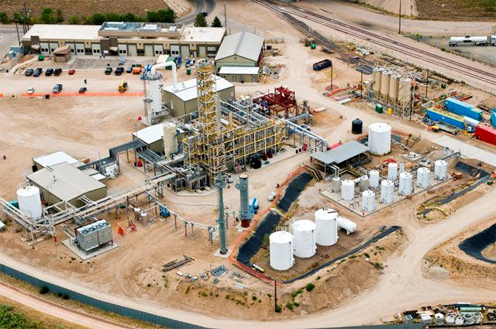
Rentech's Product Demonstration Unit in Commerce City.
Courtesy: Rentech, Inc.
Rentech looked like it was poised for success in 2010 when United Airlines successfully flew an A319 Airbus, which was powered in part by RenJet, the synthetic fuel produced at the Commerce City facility, out of Denver International Airport. Forecasts for how this development could change the industry were good but economics kept the drop-in fuel from becoming a staple in the industry.

Reports say that Rentech would need more than $1 billion to bring the technology to a large enough scale to make the process economic and potential customers haven’t been willing to agree to long-term contacts to make financing easier. Rentech will attempt to sell the five-year old facility it built in Commerce City for $85 million as well as the 450 acres of land it still owns in Natchez, Miss.

The company expects to cut its R&D budget from $21 million in 2012 to $10 million in 2013. It has no plans to spend any money beyond maintaining intellectual property in 2014.

Better BTU Take: We were skeptical of Rentech’s chances for success from the beginning, noting in our first blog that the company seemed to be throwing large amounts of money around hoping to hit the target and strike it rich. Although the company may have been able to prove its technology, it wasn’t able to bring it to large-scale production due to cost and that is one of the reasons we support building the industry on smaller scale projects.

Rentech to Close Product Demonstration Unit – Rentech Press Release, Feb. 28, 2013

Rentech to Shutter Research Plant in Commerce City, Cutting 65 Jobs – By Aldo Svaldi, The Denver Post, Feb. 28, 2013

Rentech in Reverse – Better BTU Technology Blog, Apr. 24, 2012

Jet Fuel's Future on the Front Burner – By Ann Schrader, The Denver Post, Aug. 1, 2010.

Friday, December 28, 2012

Fulcrum Clears Financial Hurdle to Rev Up Construction in 2013


Three years after announcing its breakthrough in converting MSW to ethanol, Fulcrum BioEnergy appears to have secured all the funding necessary for its first MSW to low-carbon fuels plant in Storey County, located 20 miles east of Reno, Nev.

The Pleasanton, Calif.-based company landed a $105 million loan guarantee by the U.S. Department of Agriculture in August. Fulcrum originally filed a registration for an initial public offering with the Securities and Exchange Commission in September 2011 but rescinded its filing later.

Courtesy: Fulcrum BioEnergy
“The current IPO market environment remains challenging, especially for development stage companies like Fulcrum,” President and CEO James Macias said. “Because of this we have secured commitments from alternative capital resources to advance our MSW to renewable fuel program and we have withdrawn our registration statement.”

Fulcrum also closed an equity investment agreement with Waste Management in November 2011 that could provide up to $70 million for the Sierra BioFuels plant. The proposed plant is expected to produce close to 10 million gallons of ethanol each year. The company secured its feedstock and entered an offtake agreement for the plant in 2009. In addition to ethanol, the Sierra BioFuels plant will produce its own renewable energy to run the plant.

Fulcrum uses a two-step process to convert post-recycled MSW into ethanol. An InEnTec downdraft partial-oxidation gasifier is used to convert the sorted MSW to a syngas. The syngas then runs through a catalyst in Fulcrum’s proprietary alcohol synthesis process which it developed with Nipawin and the Saskatchewan Research Council before the ethanol is finally separated and purified.

The basis of Fulcrum’s business strategy is to secure zero-cost feedstock agreements around the country, thus giving it a competitive advantage over those who use corn or other forms of biomass. While Fulcrum has only just started construction on its Sierra BioFuels plant in Nevada, the company currently has feedstock agreements in 23 other cities across the U.S.

Better BTU: Fulcrum’s turning point was landing the $105 million loan from the USDA. The government has laid out significant dollars in an attempt to jumpstart development of biofuel technologies that utilize non-food feedstocks.  While we’d still like to see the industry focus on clearing one hurdle – clean, economic and efficient gasification – before approaching the next, we like Fulcrum’s business approach. Still a lot has to happen if the plant is to be in production by the end of 2013, as the company states. We’ll be keeping our eyes peeled for news out of Nevada.

Recommended Reading:

Fulcrum Secures $175M for Waste-to-Fuel Gasification ProjectWaste Management World (Dec. 3, 2012)

$105 Million USDA Loan Guarantee for Waste-to-Biofuel FacilityWaste Management World (Aug. 7, 2012)

Monday, July 9, 2012

Project Update: Sundrop Fuels Aligns Itself With Another Big Player for Inaugural Site


We first brought you the story of Sundrop Fuels in December, after the advanced biofuels company announced plans for its first commercial project near Alexandria, La. The Colorado-based startup is significantly backed by big names, including strategic partner Chesapeake Energy Corp., with additional investments from Oak Investment Partners and Kleiner Perkins Caulfield & Byers. 


Now Sundrop Fuels will be working with another big name in the industry as it continues forward progress on its inaugural project in Rapides Parish, La. The gasification-based advanced biofuels company has signed a licensing agreement with ExxonMobil to use its patented methanol-to-gas technology at its facility.

Sundrop Fuels announced plans for its alternative fuels project in Nov. 2011. With plans to break ground by the end of the year and a goal of being in production by 2014, the company's first commercial plant is designed to produce up to 50 million gallons of renewable gasoline per year. 

Adding ExxonMobil to the mix strengthens Sundrop's safety net because it means that one more major company has a stake in the project's success. The methanol-to-gasoline process was developed in the 1970s and successfully commercialized for a large-scale natural gas-to-gasoline plant in the 1980s in New Zealand. The Louisiana project would mark the first time the MTG process is used for the production of biofuels.

The success of the Louisiana project is crucial for Sundrop Fuels, which needs a commercial installation of its RP Reactor to prove its radiant particle heat transfer gasification technology. The company hopes to use this project as a stepping stone for future massive-scale biofuels plants that can produce more than 300 million gallons of renewable, drop-in biofuels annually. 


Further Reading:


Tuesday, December 13, 2011

Liquid Fuel: The Holy Grail of Biomass

Imagine a world where the conflict in the Middle East doesn’t determine the price of filling up your car in America. According to Sundrop Fuels, it could be a reality sooner than you think.

Image courtesy of Waste Management World. 
Although only in business for three years, Sundrop Fuels is already making big strides in the advancement of “green gasoline.” Based in Colorado, the company produces advanced biofuels by gasifying cellulosic feedstock. The result is a clean renewable form of fuel that can be used in combustion engines, such as automobiles. 


And now Sundrop has a site for its inaugural facility. The company announced on Nov. 22, 2011 that it has purchased 1,200 acres of land near Alexandria, La. to build its first production facility. Aiming to be running at full speed by 2014, Sundrop Fuels estimates it will be able to produce close to 50 million gallons of “green gasoline” annually.

Unlike similar projects in the liquid fuel experiment, Sundrop Fuels hasn’t received federal loans to subsidize its project. The state is allowing the sale of tax-exempt private activity bonds and will offer standard performance-based incentives for the 150 new jobs the plant will bring to Alexandria, but both of these initiatives involve no risk to the taxpayer. This comes as a relief to many who are familiar with the $156 million loans the now-defunct Range Fuels received for its failed project in Mississippi.

So where is the money coming from for this $450-500 million facility? Chesapeake Energy Company became a 50 percent stakeholder in the company in July with a $155 million investment. Oak Investment Partners and Kleiner Perkins Caufield & Byers have also made $20 million investments and hold spots on the company’s Board of Directors.

While the forward motion on the project is exciting, many experts in the industry feel we are still at least a decade out from seeing any measurable results. The recent announcement of Range Fuel’s bankruptcy also serves as a reminder that we are still in the pioneering stages of this industry.

Better BTU Take: Big bets by big guys makes this a project worth following.